

Do you ever wonder about the futures that never were for yourself? Do you catch yourself sometimes pondering what could have been a different outcome of a decision years ago? Do you ever imagine the choices you’d make from an option you never thought you had? In The Home We Remember by Hamnah Shahid (and additional design work by Gwendolyn Kelly, Cai Kagawa, Amir/Nada Alami, and Sea Thomas) we as people are asked to play exactly as ourselves, all possible versions of ourselves, including the “what could have been” of our lives. How many versions of you exist? How many could have?
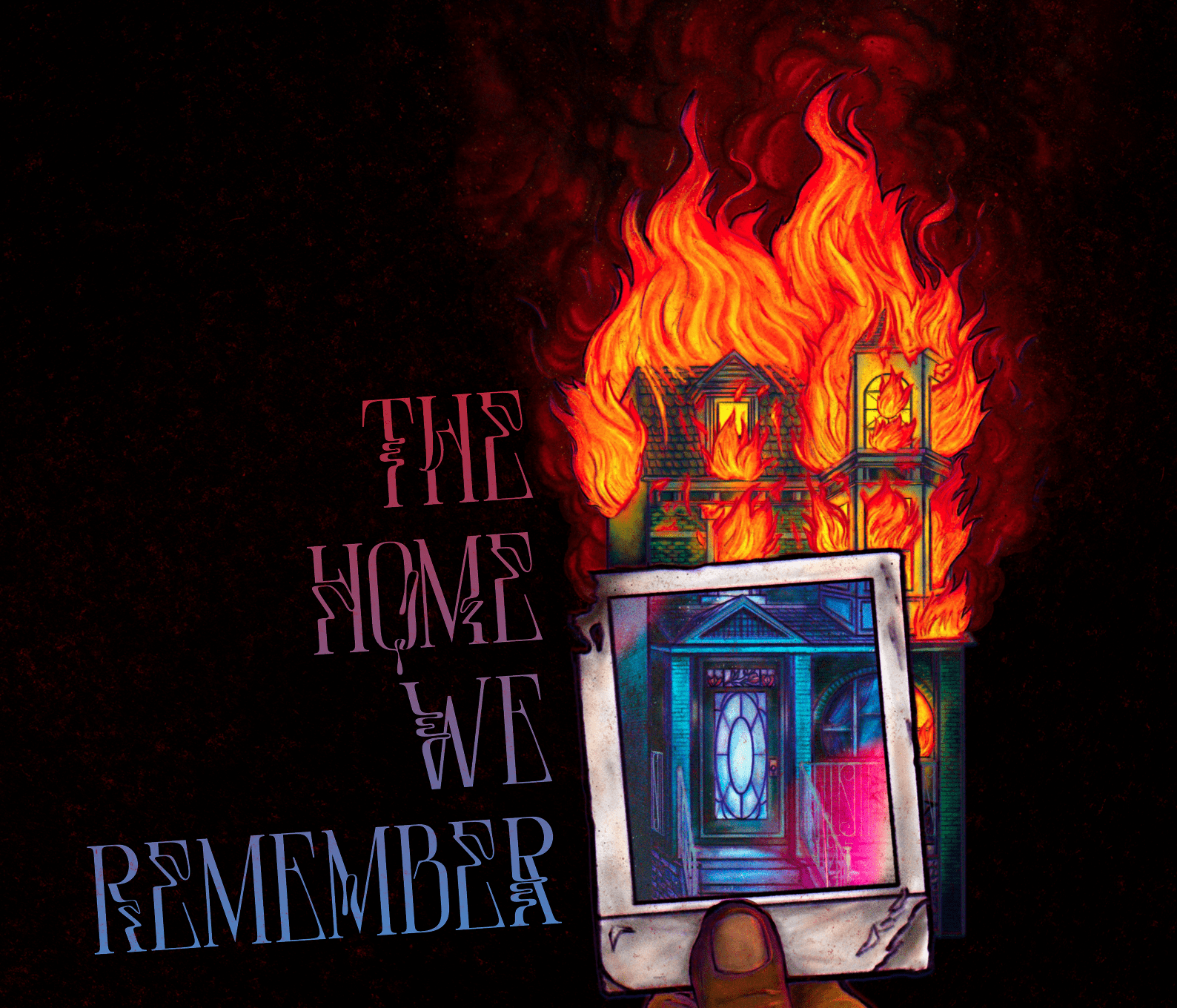
About The Home We Remember
The Home We Remember, published by Frivolous Bear Studios in conjunction with Tendervicious Studios, is a tarot driven TTRPG ashcan that embodies magical realism. It centers Player Characters as a Tragedy befalls their town and Home. You cannot prevent this tragedy from coming, you can only hope it’s not as bad this time around. The tragedy has happened before and will happen again. The game states at the very beginning that “Time is Space and Space is Time”. The past, present and future are distinctions that only we as people living in a linear time and three dimensions need to describe our own life experiences. Within The Home We Remember these dimensions are not needed as all of them are one. Let’s dive deeper now…
Mechanical And Visual Language
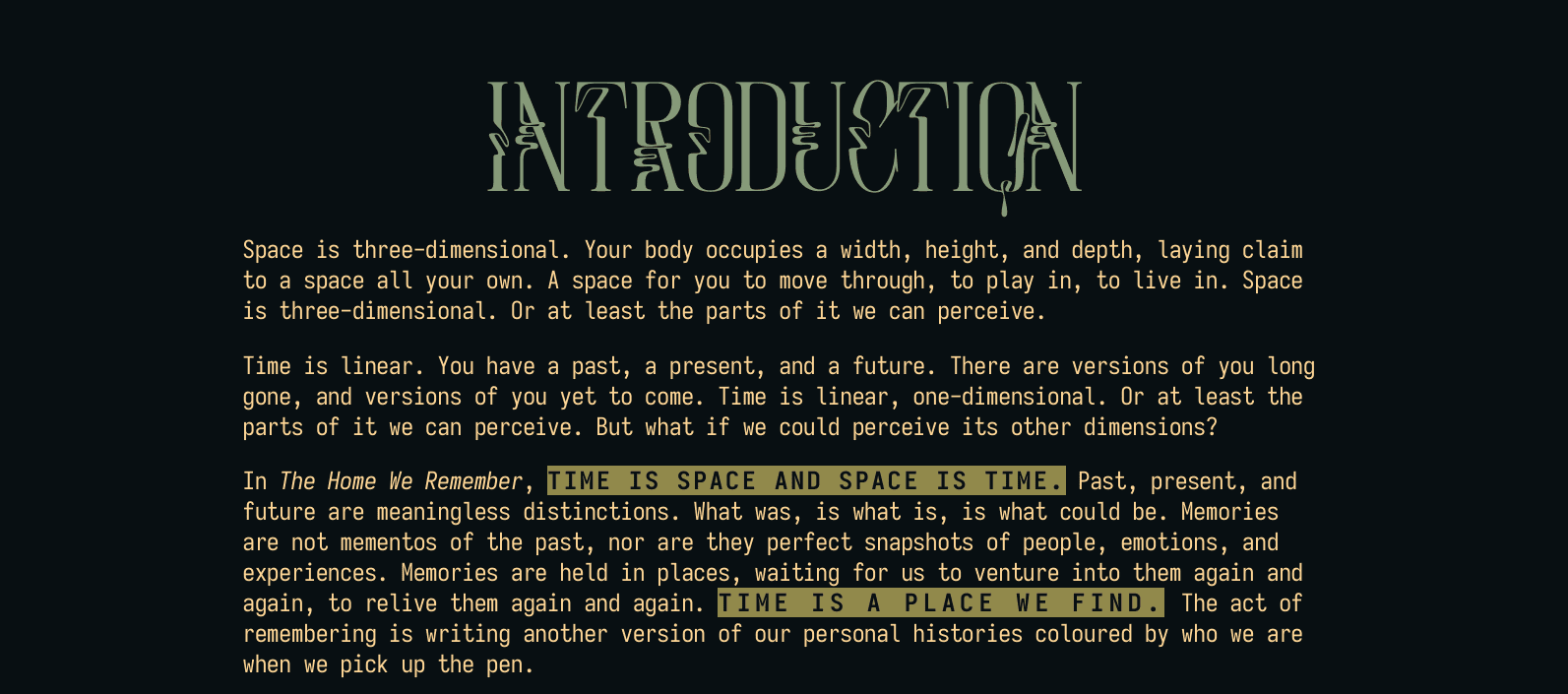
One player takes on the role of ARCHITECT, embodying the Town, Home, and NPCs of the game while the Player Characters play to discover each version of themselves and who they will be, for better or for worse. You create your characters by creating TETHERS, symbols and metaphors about your PC. Flora and fauna, an item, a scent, a sound, and a time of day (morning, afternoon, sunrise, or quitting time), and finally drawing an ANCHOR tarot card. With the Anchor you are asked to contemplate the meaning and symbolism of the tarot card, all it is, can be, and what you struggle against. At this point, the game asks you to look in the mirror and ask yourself four questions: Who are you? What is your strength and how is it a weakness? What is your weakness and how is it a strength? What is hidden, unfinished, or broken beyond repair in your life? The final question stands as your character’s crux of their non-linear story arc in the game. You then create Relationships with other PCs, NPCs with all the complexities that they deserve, and three Core Memories. After this, the game begins at its end: The Tragedy. While I have not had time to play out my own Tragedy yet, I hope to soon enough.
My biggest critiques of The Home We Remember are two fold: first being layout and second being related to the ashcan nature of the game. The layout is beautiful, it has a strong visual language, knows what it wants to say and how to say it. It’s not easy to read. Some of the lines take up most of the page in single columns, the rare double columns also take up large parts of the page. Some pages have beautiful portraits to break these paragraphs up but for the most part, this game can feel like a very long read for what is ultimately an otherwise breezy one. While the book requires you to sit and think about what you’ve read (which is a positive), for me it felt like Sisyphus pushing his boulder to try and read through this otherwise gorgeous game. Art in certain places can help break up these pages to make them easier to read. Secondly, the fact that Actual Play is the main method of learning to play The Home We Remember right now is something I see as holding this game back. The Home We Remember needs to stand on its own outside of an Actual Play of experimental mechanics that may not end up in the final version. If someone has to learn the game using an Actual Play, I tend to view it as an accessibility issue and it’s especially true for folks who don’t have stable access to the internet. I can also can see issues appearing where groups can’t agree on how the game should be run in terms of mechanics. Personally, I think Actual Play should not be the first line in learning a game, it should be secondary or tertiary. Supportive but not the guiding star. Actual Play shouldn’t come first in terms of TTRPG design. Using Actual Play as a part of teaching The Home We Remember, how to play and run the game, should not be the main way of learning a game that presents itself as a mechanical example of an almost complete piece. The Home We Remember sings and I want to watch it soar.
An Ashcan and Art Piece in Progress
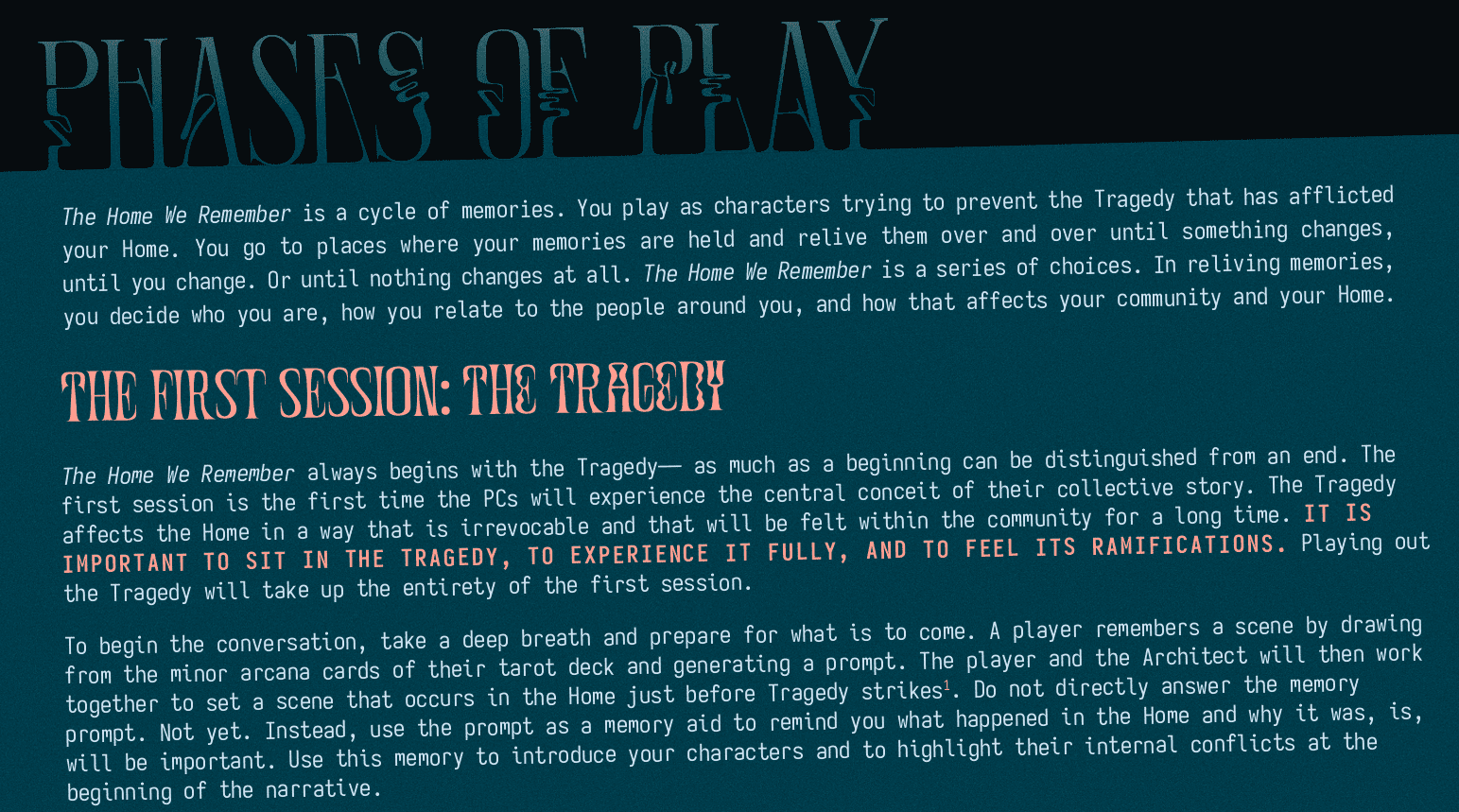
The Home We Remember as mentioned before is an ashcan, or mostly finished enough to be played in a satisfying manner, but the entire game has not been released. Only five cards from the Major Arcana and twenty from the Minor Arcana are in the ashcan and, while all prompts have been written, it may take a little more of our linear time to have a full release. This does not detract from my experience of reading the game and in fact makes me want to write and explore my own version of “what could be”. It’s enough to get through several sessions, from my estimate three to five of them for most groups, and have an ending to a game that is not yet fully released. To me, this feels rather fitting given this game and what it accomplishes in the space it has. The Home We Remember is a game that appears hard to learn and hard to master and it may well be for some. However, I see it as something that adds to the game as opposed to a detriment. Trying to figure out this game for me was like trying to untangle my own relationships from who I am. You can’t do it, you must accept that this game (and you) exist as a part of a whole system of other people you know exist and you’ve never met that made this possible.
On “What If?”
“The act of remembering is writing another version of our personal histories coloured by who we are when we pick up the pen.” – The Home We Remember.
“If is the biggest word in the English language.” – my father, his father, and likely his father too.
The human brain is not infallible. It forgets, overwrites, misremembers. Every time you try to recall a memory something small, minute, seemingly unimportant is changed. As this goes on, whole memories are changed little by little in detail until it is no longer what it was. This is also true for people as they are. When we look back at ourselves and what we have done, we are no longer that person. We have hopefully grown and changed for the better. Sometimes we don’t, but we have changed nonetheless. The Home We Remember asks us to look at the what could have happened, the what may happen, what has happened, and the what if’s of our lives, extends a hand, and asks us to explore it together. The Home We Remember is a game with a heart that screams, beats, and bleeds all at once. It’s beautiful, touching, and haunting. It’s a tender ache in the mind and memory. I love The Home We Remember because it is attempting to create itself. Now, go find you and all the versions of yourself.

Have strong thoughts about this piece you need to share? Or maybe there’s something else on your mind
you’re wanting to talk about with fellow Fandomentals? Head on over to our Community server to join in
the conversation!