

John Chu’s The Subtle Art of Folding Space is the kind of science fiction novel that is not centered around explaining the universe. It asks what it costs to hold one together. Beneath its exhilarating premise of quantum instability, universe-maintaining machinery, and a dangerous secret device lies something far more intimate. We have a story about inheritance and the quiet, persistent gravity of family, no matter how dysfunctional.
In The Subtle Art of Folding Space we meet Ellie, whose world is unraveling in more ways than one. Her mother lies in a coma, suspended between life and death by forces not fully understood. Her sister, Chris, is both her adversary and mirror. She accuses Ellie of cultural detachment even as the two are being pulled into the same collapsing orbit. Somewhere beneath it all hums the skunkworks, a system responsible for maintaining the laws of physics across the universe. Chu renders this concept with enough clarity to intrigue its readers.
What makes The Subtle Art of Folding Space stand out is how it does not try to be traditional “hard”, technically heavy science fiction. The physics are elastic and almost emotional in their logic. Instead of dense exposition, Chu gives us sensations like the unease of things not quite working, the creeping dread of a reality developing unexplainable glitches, and the way a single device can both sustain life or unravel existence. The illicit machine Daniel, Ellie’s cousin, discovers is a tool that is doing a very specific job, both supporting life and at the same time destabilizing an entire universe. This is the novel’s most potent metaphor. It embodies the central question of what we are willing to break in order to keep the people we love.
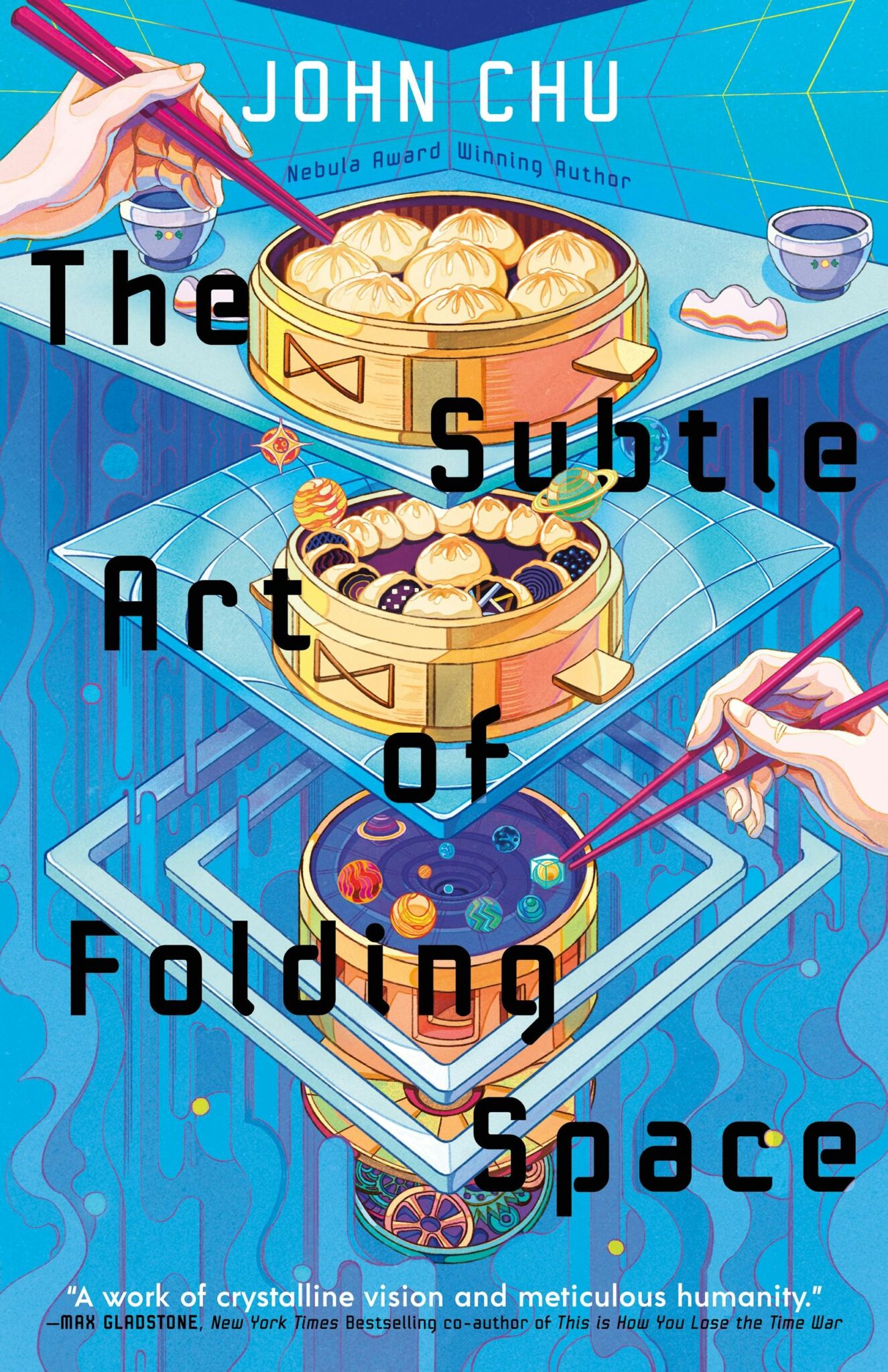
PHOTO COURTESY OF PUBLISHER
Chu’s prose is controlled and quietly devastating. He has a talent for embedding emotional weight inside seemingly casual observations, allowing grief and resentment to seep through the cracks of dialogue and description. The result is a narrative that feels layered without becoming inaccessible. Event at its most ambitious, The Subtle Art of Folding Space remains character driven.
Ellie is a particularly compelling protagonist because she is not heroic in a conventional sense. She is uncertain and conflicted. She is often overwhelmed by the forces she is trying to understand and help repair. Her struggle with cultural identity and being seen as “insufficiently Chinese” by her sister adds another dimension to her inner conflict. This is not treated as a side note or token tension. It is how Ellie views herself and her place within her family. Chu does not easily resolve this but rather he presents identity as something personal and sometimes painfully contested by those who should love us most.
Chris is more than just an antagonist to Ellie. She is sharp-edged and often unforgiving. The tension between the sisters is one of The Subtle Art of Folding Space‘s strongest threads. It is charged with years of unspoken hurt and misunderstanding. Their interactions crackle with authenticity, even when filtered through the heightened stakes of assassination attempts and reality collapsing. It’s in these moments of arguments over culture and responsibility that the novel feels cemented in it’s deeply emotional themes.
Daniel provides a different perspective, acting as an observer. His discovery of the illicit device sets much of the plot in motion, but he also is a reminder of how entangled the personal and the cosmic have become. In Chu’s world, there is no clean separation between family drama and universal catastrophe. One feeds into the other and each escalates the stakes until they become almost indistinguishable.
And then there’s Ellie’s mother. She is largely absent physically, but profoundly present throughout the novel. Her coma is not just a plot device but a gravitational force around which the narrative revolves. Through fragments of memory and revelation, Chu constructs a portrait of a woman whose legacy is both brilliant and carries immense weight. The deeper Ellie digs into her mother’s situation, the more complicated this legacy becomes. Love and resentment intertwine, making admirations burst with flashes of anger.
One of The Subtle Art of Folding Space‘s most distinctive features is how it weaves cultural specificity into its speculative framework. The inclusion of traditional Chinese dishes, for instance, is not just a charming detail, but a grounding ritual for our characters. It is a reminder of some continuity in a world that is otherwise quite literally breaking apart. These moments of sensory familiarity focusing on food, language, and shared history root the story and give the readers something to hold onto as the more abstract elements of the plot unfold.
Chu’s pacing is not rushed. He takes care and time, allowing the emotional arcs to develop alongside the scientific mysteries. This means the novel at times lingers in introspection. The deliberateness of this is a strength in that it mirrors the characters’ own hesitation and reluctance to confront truths that may shatter what little stability they have left.
As The Subtle Art of Folding Space builds toward its climax, the stakes become unbearably high. Ellie is forced into an impossible choice. She has to decide to preserve the universe or preserve her family. It’s a classic science fiction dilemma and Chu imbues it with such personal weight that it feels brand new. This is not just about saving the world but about deciding which version we can live with.
What sticks with us after the journey ends is not the mechanics of the skunkworks or the intricacies of interdimensional physics, it is the emotional residue. The Subtle Art of Folding Space is a novel about the trauma and expectations we inherit and the ways’ they shape us, even when we try to break free. It asks whether it is possible to repair what has been broken without inflicting further damage and whether understanding the past is enough to change a future.
Chu gives us a story that feels as unstable and complex as the universe it depicts. It is one where every choice has consequences, and where holding things together often requires letting someone else fall apart. In the end, The Subtle Art of Folding Space depicts surviving the laws of the universe rather than simply mastering them. This debut novel feels both ambitious and deeply personal, marking Chu as a voice in science fiction who understands that the most compelling stories aren’t just about what’s out there, but about the vastness and complex systems we carry within us.
Thank you so much Tor Books for sending me an early copy for review. This book is really great and any fans of sci-fi with heart would eat it up. You can pick up The Subtle Art of Folding Space on April 07, 2026 wherever you buy your books!
Have strong thoughts about this piece you need to share? Or maybe there’s something else on your mind you’re wanting to talk about with fellow Fandomentals? Head on over to our Community server to join in the conversation!