


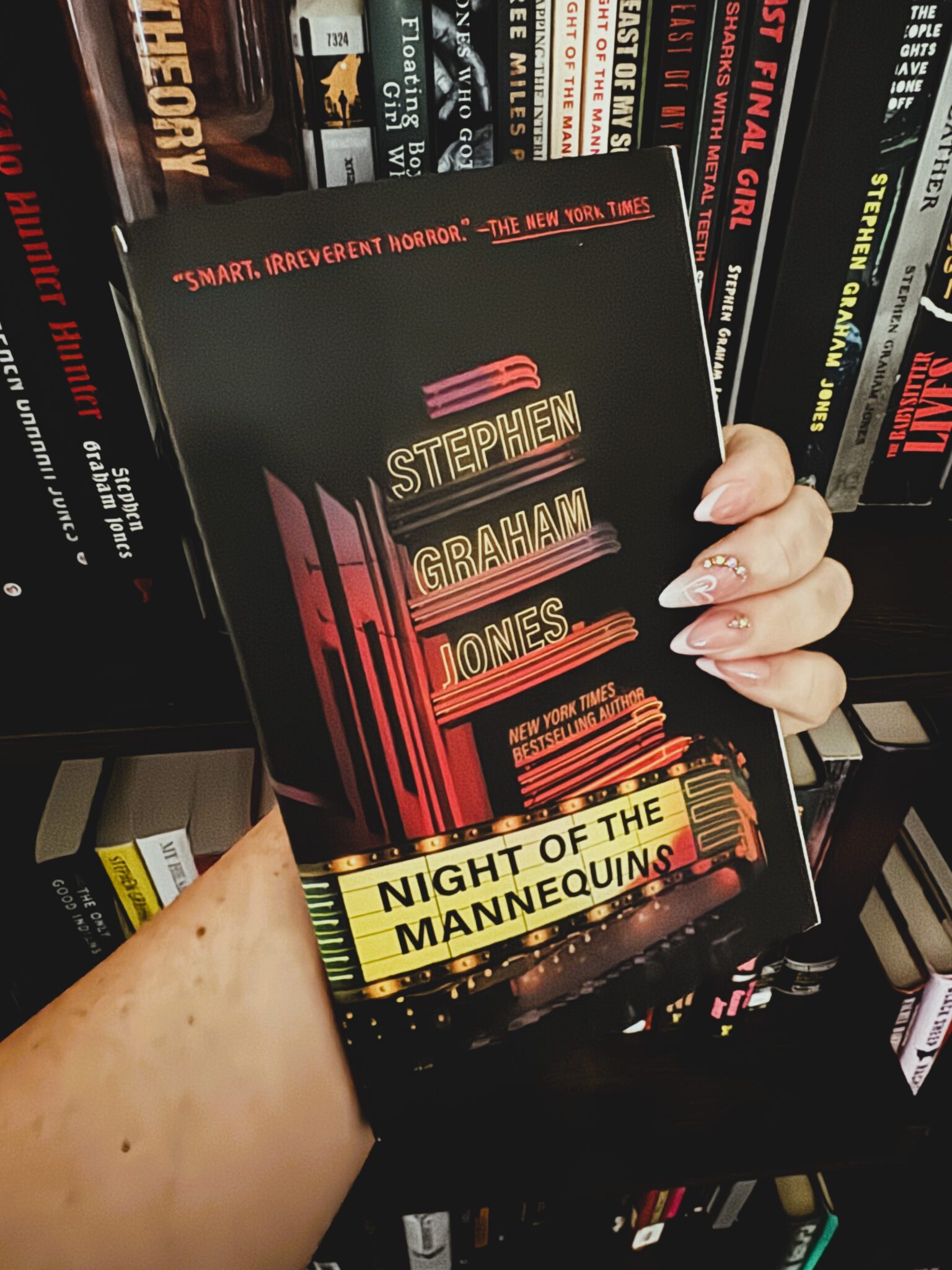
Stephen Graham Jones’ Night of the Mannequins is a novella that is bitingly sharp and deeply unsettling. These characteristics are displayed in ways beyond gore. They have to do with proximity. Proximity to a mind bent on justification. Proximity to a voice that sounds completely reasonable, until the moment it isn’t. Tor Nightfire is rereleasing this gem of a book with a brand new, gorgeous cover as a trade paperback, so let’s talk about it.
Winner of both the Bram Stoker Award for Best Long Fiction and the Shirley Jackson Award for Best Novella, both in 2020, Night of the Mannequins exemplifies Jones’s singular talent for weaponizing perspective. I will keep this review as spoiler free as possible for new readers. The premise is deceptively simple: a group of teenagers pull a prank involving a mannequin and a movie theater. From there, things escalate into a slasher-geared rampage. But Night of the Mannequins is not interested in the mechanics of said slasher so much as the moral gymnastics required to sustain them.
The story is told entirely through the perspective of Sawyer, a teenage boy who becomes convinced the mannequin is alive and that he must save his friends from its nefarious intentions. This is where Jones performs his most unnerving skill. He makes Sawyer convincing. Or, rather, he makes Sawyer sound convincing. His narration is casual and confident. It is steeped in a self-appointed sense of responsibility. He isn’t a raving mad lunatic or some monster lurking in the margins. He is a boy who wants to do the right thing. That belief, articulated in first-person with relentless certainty, is what turns this novella into something far more disturbing than your traditional horror body count.
Jones has long been interested in how stories are told and who gets to tell them, and Night of the Mannequins is an ode to the unreliable narrator done by a master of his craft. Sawyer does not question his own logic. He narrates as though the conclusions he draws are obvious, even inevitable. His internal justifications about sacrifice, heroism, and necessity mirror the rhetoric often used to excuse real-world acts.
Night of the Mannequins’ horror lies not in whether the mannequin is actually alive, but is it? An extra interesting bit to note is the ease with which Sawyer’s reasoning slides from one place to another. The novella’s slasher DNA is unmistakable. It contains the formula: teenagers, escalating violence and a nagging sense of inevitability. There is no cathartic showdown, no clear line between victims and villains. Instead, readers are trapped in Sawyer’s head and forced to follow each step of his thought process as it tightens into something inescapable. The kills themselves are often abrupt to the point of feeling incidental, as thought the narrative, much like Sawyer, refuses to leave room for doubt.
Stylistically, the prose is lean and propulsive, giving Night of the Mannequins its breathless pace. Jones uses casual phrasing to lull the reader into familiarity, mimicking the rhythms of immature, teenage speech while also quietly twisting them. Sawyer’s voice feels authentic in his narrow emotional intelligence and brittle confidence. That authenticity is precisely what makes this story so effective. We are not asked to sympathize with Sawyer so much as understand him, and that understanding is deeply uncomfortable.
There is also something quietly devastating about how Night of the Mannequins interrogates hero narratives. Sawyer sees himself as the appointed protector. A willing actor to do what others can’t. His version of heroism is rooted in control and certainty instead of care and empathy. Jones never lectures the reader, but the implications are clear. When we frame violence as necessary and moral certainty goes unchecked, the result is catastrophe.
The mannequin itself is blank and passive. It is an object upon which Sawyer can project his fears and justifications. Whether the mannequin is animated or not matters less than the fact that Sawyer needs it to be. The mannequin becomes an excuse and a catalyst that transforms his ordinary friendships into abstract problems that need to be solved. In that sense, the true horror is not that an inanimate object is alive. The true horror is how an individual can dehumanize the people around them.
At its diminutive page count, Night of the Mannequins wastes no space. It is ruthless and sharp as a razor, leaving readers with a sense of unease and no easy resolutions. Jones trusts his readers to sit with ambiguity and to wrestle with the discomfort of having followed a monstrous logic all the way to its unhinged conclusion. Ultimately, Night of the Mannequins is not about the “killer mannequin”. It is about the stories we tell ourselves to justify unsavory choices. It casts a lens on the danger of certainty with zero reflection and the hair thin line between being the hero and becoming a monster. Jones delivers a slasher that cuts inward and leaves scars that ache.
Needless to say, I loved this novella. There is nothing quite like Stephen Graham Jones’ style of horror. Thank you Cassidy at Tor Nightfire for sending me an advance copy for review. The new paperback will hit shelves February 24th, 2026 so make sure you snag yourself a copy tomorrow wherever you buy your books!
Have strong thoughts about this piece you need to share? Or maybe there’s something else on your mind you’re wanting to talk about with fellow Fandomentals? Head on over to our Community server to join in the conversation!