


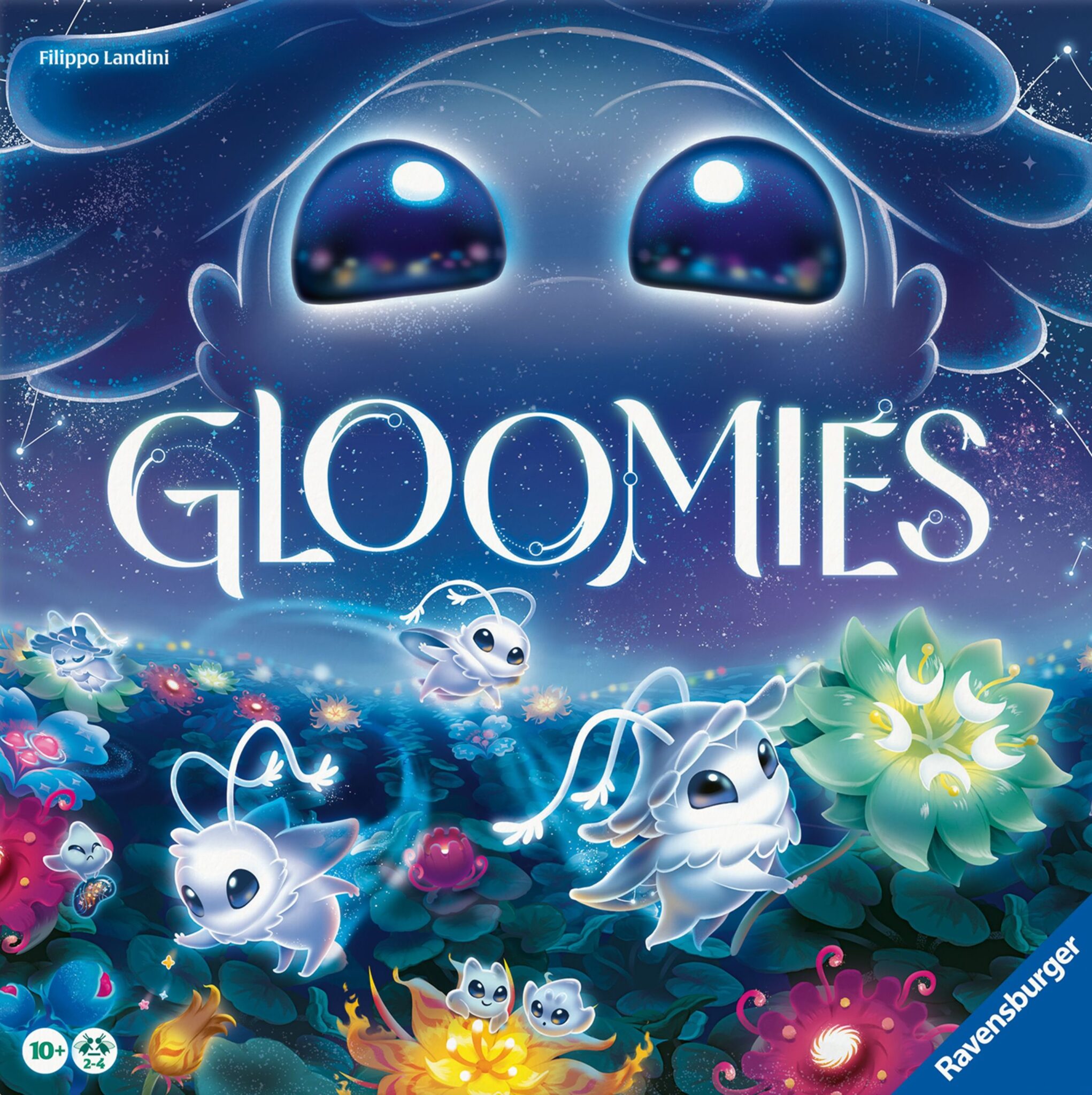
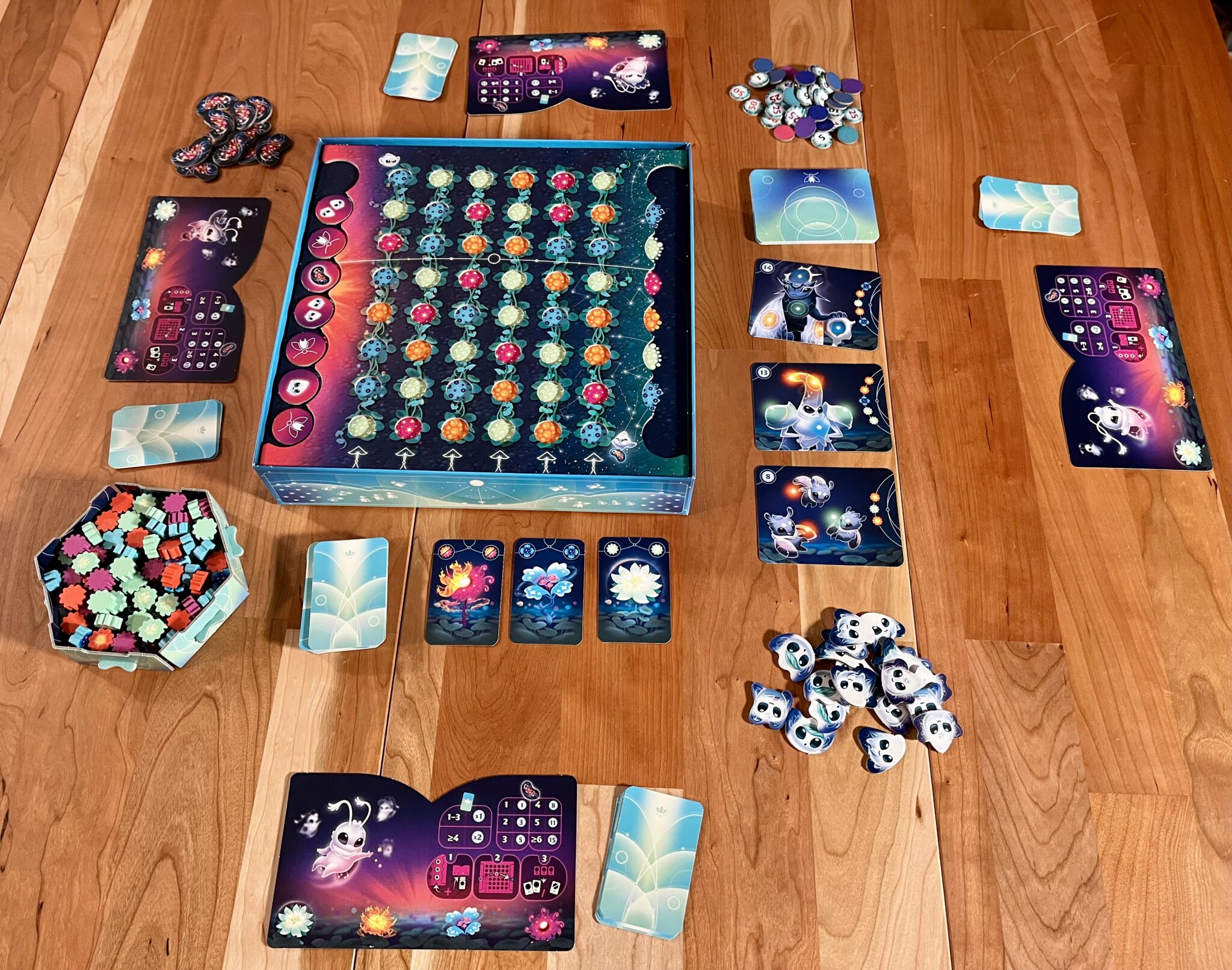
Gloomies is a game about little creatures from outer space who like beautiful flowers. You are looking to grow these flowers in the first half of the game, then harvest them for points in the second half. You will be playing cards to do this, and using a set collection mechanic to score points. The game is designed by Filippo Landini and published by Ravensburger. The game is for 2-4 players and takes about 45-60 minutes to play.
What’s in the Box?
- 1 Game Board consisting of game box, insert, and 2 layers.
- 1 Flower Storage Bowl
- 60 Wooden flowers
- 60 flower cards
- 16 order cards
- 24 double sided round bonus tiles
- 20 “little helpers”
- 12 “stardust” counters
- 48 Victory point chips
- 4 Double-sided game aids
How’s It Play?
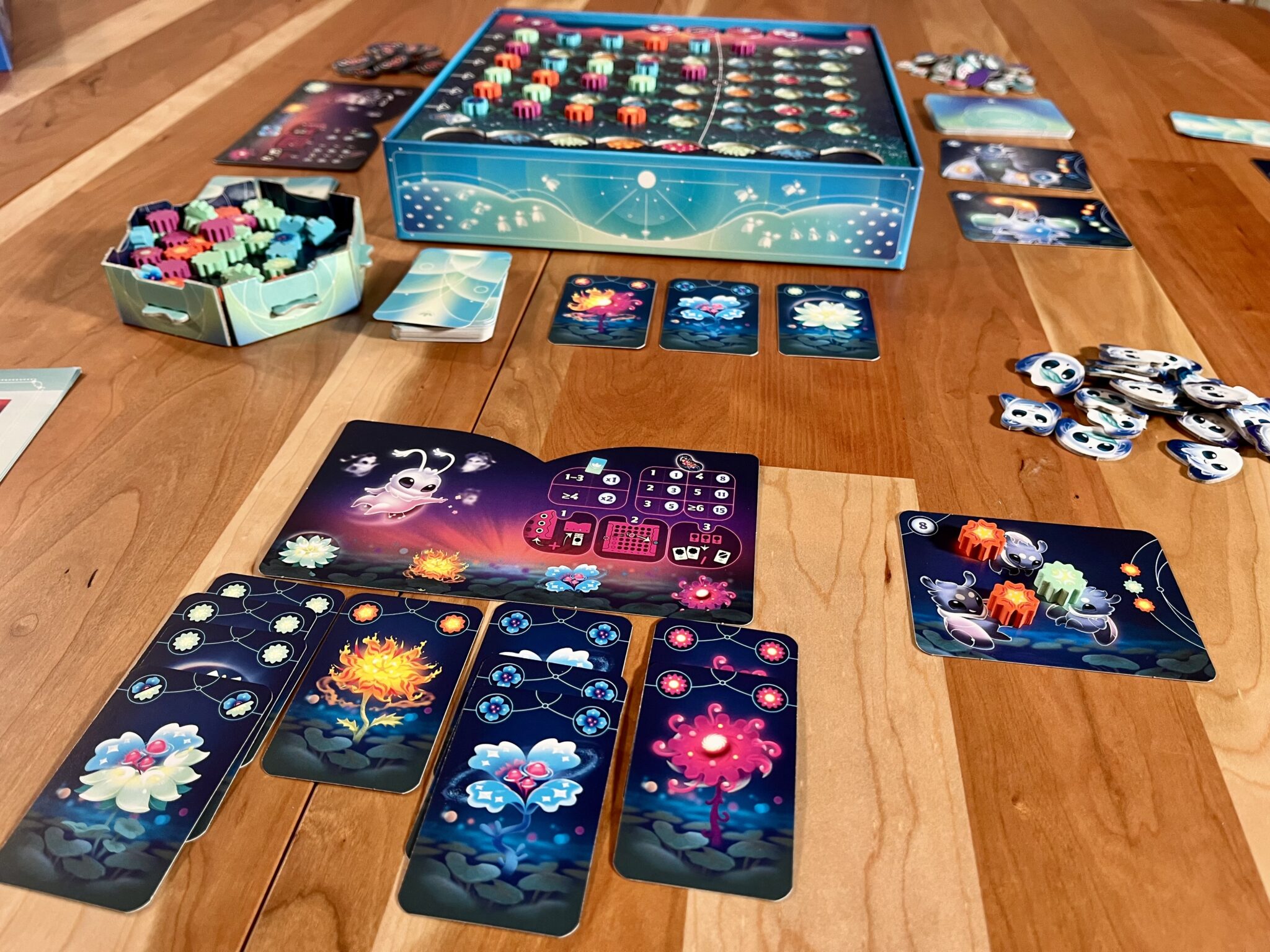
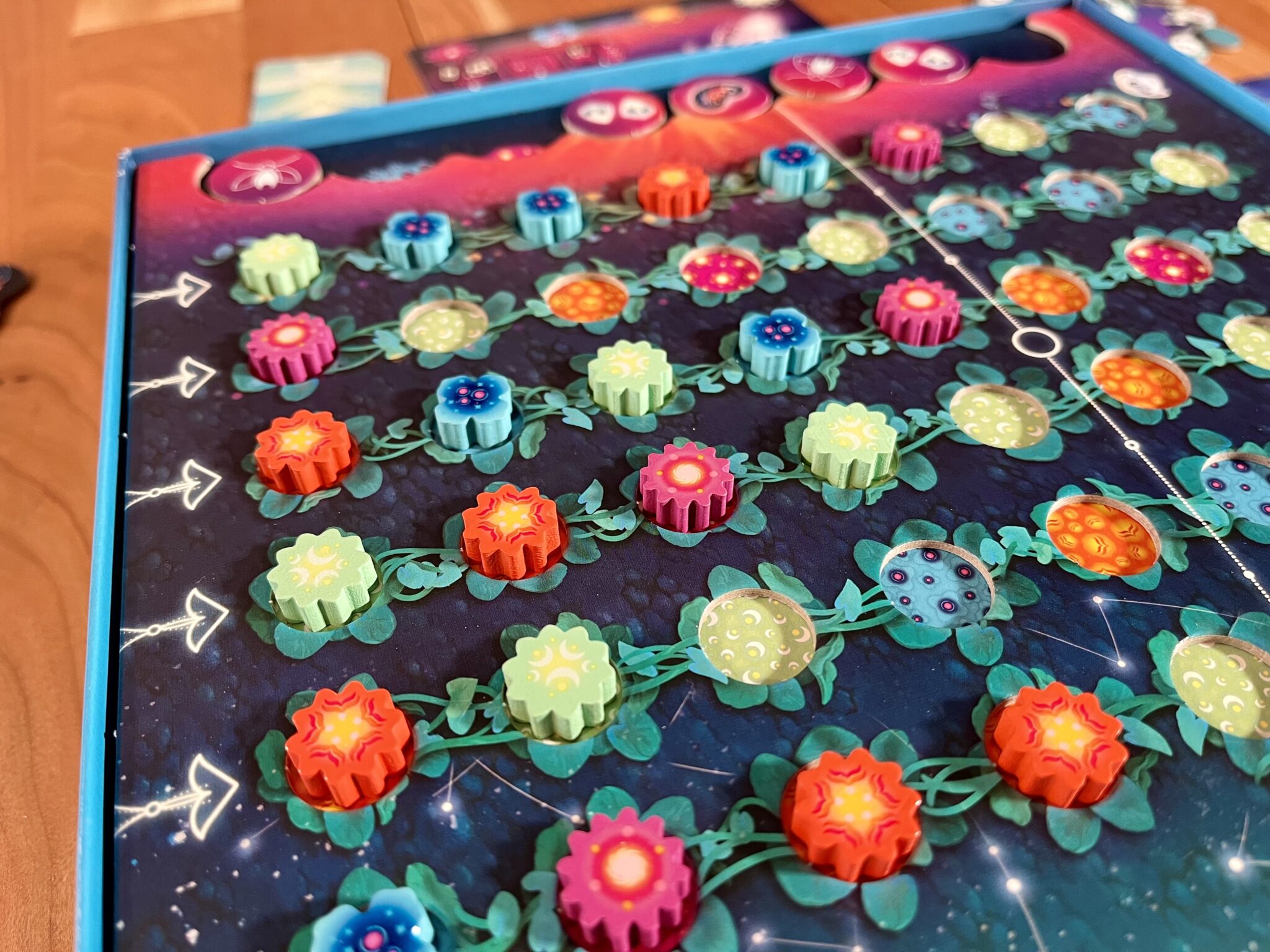
Players will be growing the board by placing flower down on the board, and as soon as the board is filled up to the white line, the game changes stages into a harvesting phase, where your previously played out cards are used to remove the flowers from the board.
When growing you play up to 3 cards from your hand to grow flowers. You will choose 1 row where you want to grow flowers and then play up to 3 cards in your hand to plant the same number of holes in that row. Cards must match the flower types seen in the holes. You always start at the edge of the board and go towards the other side where arrows are pointing.
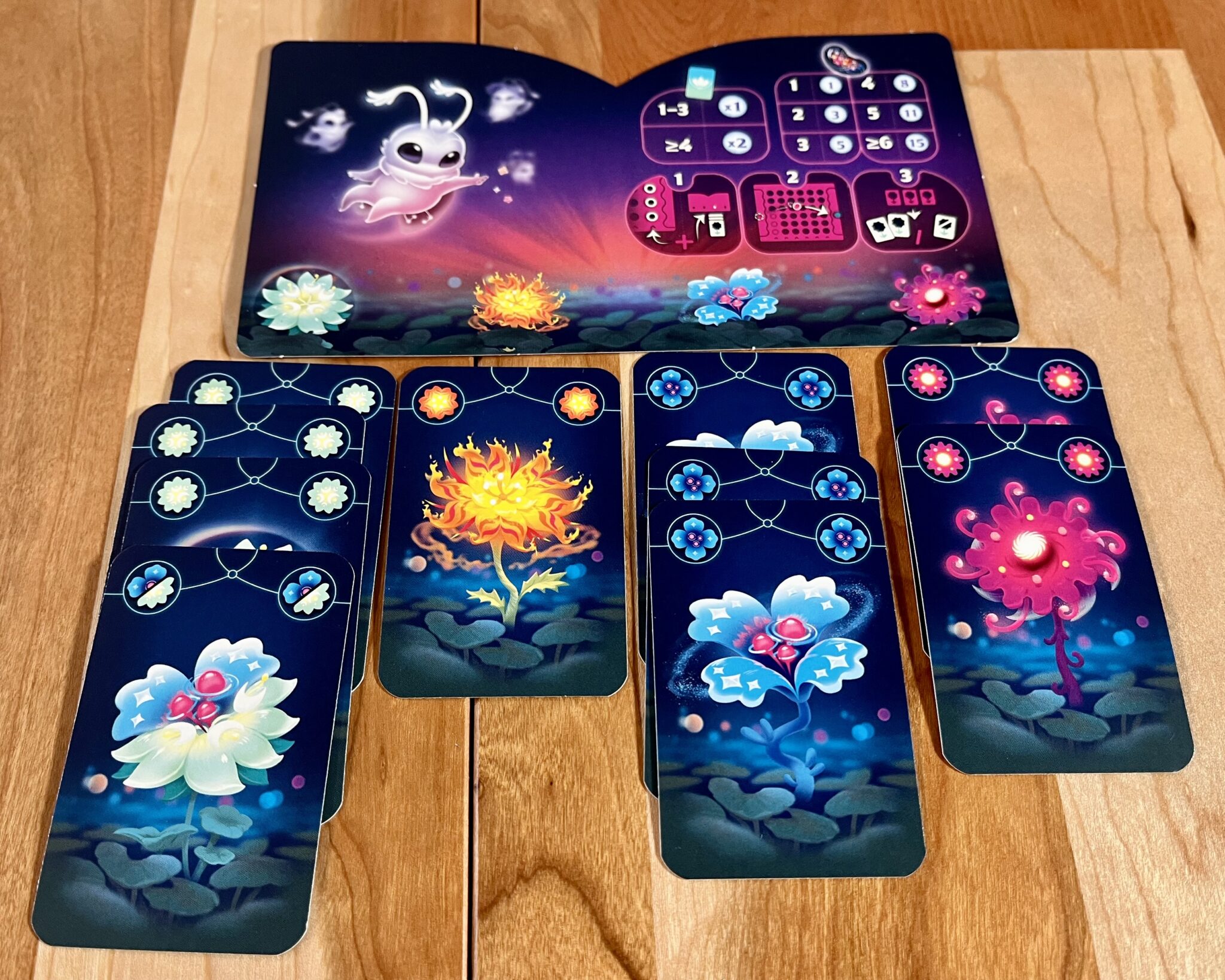
Jokers can also be used as one or another type of flower when playing. But once you decide on a row and played out to to 3 cards, you will fill the planted holes with matching flowers. Your cards are placed out sorted by flower type at the bottom of your playing aid. These cards will be collected and used to score points.
You can receive bonuses by checking your last flower placed out and taking the shown bonus. You will draw 2 cards from the display face up, or one joker and refill the display. After getting each row to the white line by adding flowers you will score points for each card you played, and if you have 4 or more of the same flower type, then each card is worth 2 points. Stardust tokens are also counted to give you points for the number you have accumulated.
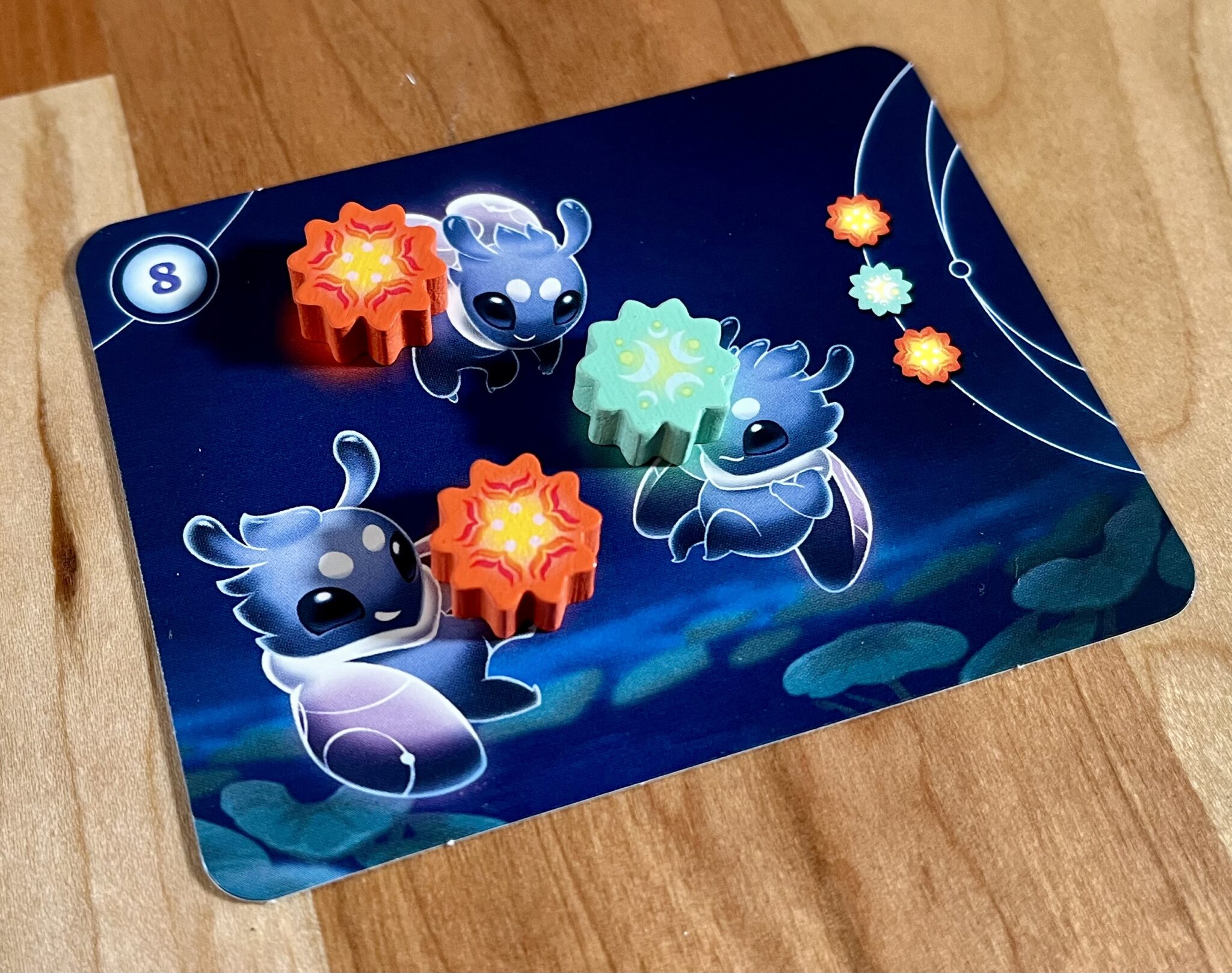
You will then play stage 2 which is the harvesting phase. You will play up to 3 cards from the cards in your hand which are the cards you have played in the game thus far. You receive the bonus from the last flower you harvest, removing those flowers from the game. Then you draw 2 cards from your deck back into your hand.
The harvested flowers are placed on orders you have collected in the game to score points, or on your game aid card which will score you some points at the end of the game. You do a second scoring phase at the end and the player with the most points wins the game.
The Verdict
This is one of those games where you play the first stage completely though, move to the second stage and play it completely through, and then the game ends. So you go through steps. So it’s a game with 2 halves. But it’s a light, easy to play family game by Ravensburger Games that might include enough complexity or depth within it to be a good pick for those who like more complex games.
The game lets everyone build and it’s easy to place down tokens and flowers, but some player might be able to do it better than others. There is less tension in this game than others, but still have some interaction as you are all sharing the board. You will have a phase of growing, and then a phase of harvest, so a build up and a tear down in the game.
The rules are simple to understand, the goals are easy to grasp. But there can still be choices to make the game strategic for those who want to be more strategic. The game can be random and unpredictable when you are not able to get the flowers you want.
The art and the components are great, and helps add to the game with the visual effect of those items. You can score in multiple ways, but you are really trying to do the same thing as everyone else, but just can settle with other ways to score points.
Overall I think it does a good job for a simple family game that adds in some complexity and shifts from one phase to the next. It’s not a game I would recommend for those who are looking for a lot more complexity or weight in their games, but it follows a Ravensburger feel with a game you can play with your kids, but still have choices.
Images via Ravensburger
Have strong thoughts about this piece you need to share? Or maybe there’s something else on your mind you’re wanting to talk about with fellow Fandomentals? Head on over to our Community server to join in the conversation!
