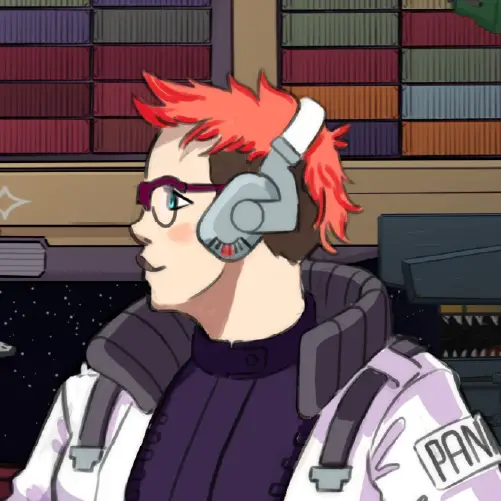

There was a time when reality competition shows took over cable. Fascinating social experiments turned into entertainment, and the early 2000s lapped it up. Those competition shows captured the imagination of Grant Nordine, the producer for Game Master Monday and their now recurring live actual play Cast Away.
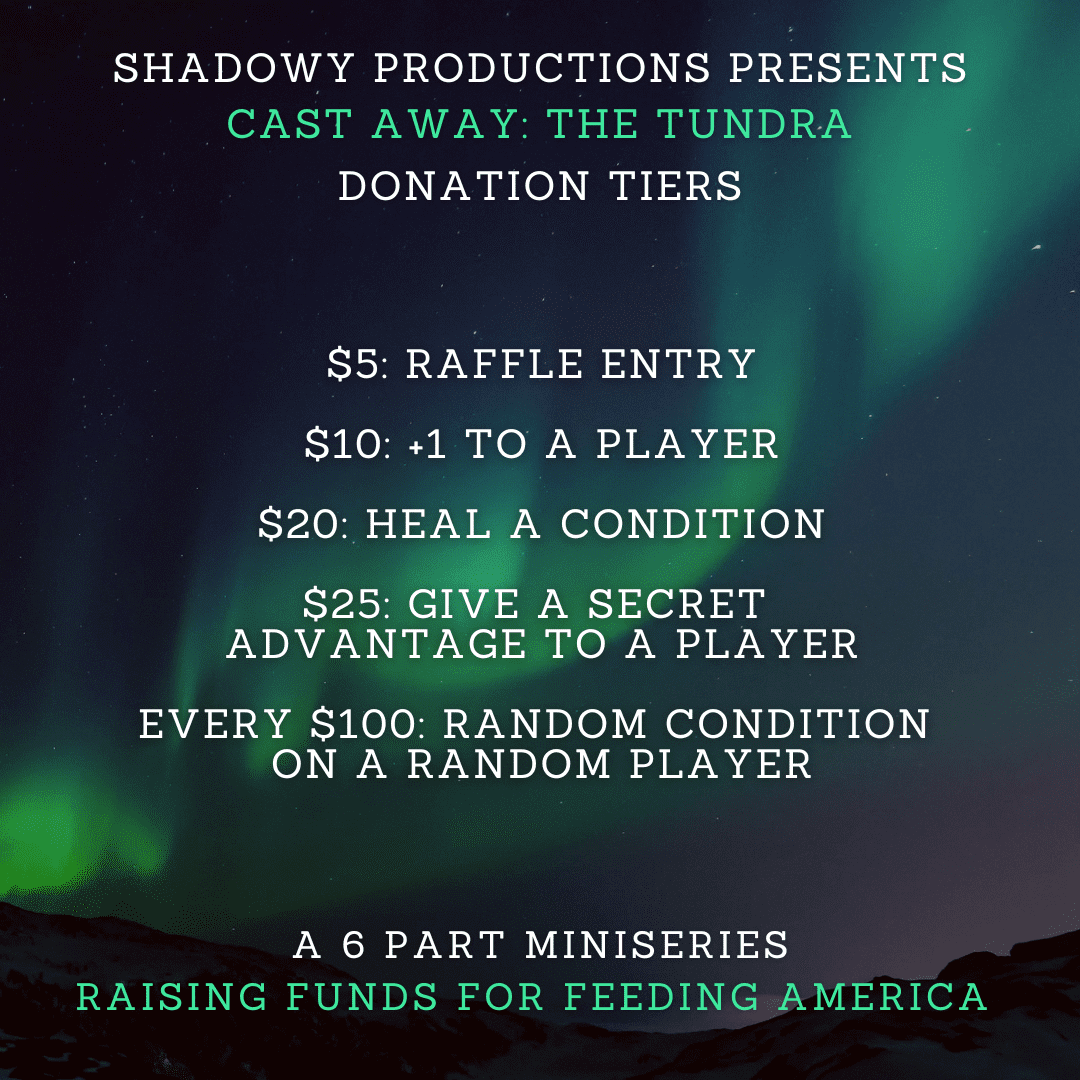
The show uses the Afterthought Committee TTRPG Cast Away, a survival game. The twist is that the entire game is framed as a very real and very deadly competition. Similar to other competition television shows, the audience can participate in the game by making donations during the live stream — influencing the player’s chances of survival. All in the name of good entertainment… and charity!
I had the chance to sit down with Grant Nordine and Jien to talk about the inner workings of running a live competition actual play.
Panda: So what’s it like to take an entire TV genre and make it into a TTRPG livestream love child?
Grant: That’s a great way to phrase it. I’ve always loved Survivor, from like minute one. I was there in 2000 when it started, back when it was Richard Hatch and Borneo and all that stuff. But it didn’t get really good in my head until season two. So season one, like my parents watched it, and then there was one guy who walked around naked, and I was like, no, thanks. But season two really clicked for me, and I’ve had an obsession with it ever since.
Because I am in the position that I am in now, where I’ve been making AP, I guess at the time of Cast Away, starting like what, two and a half years? Two years. Everything I consume now, the question is always in the back of my head: Can this be an AP (actual play)? Can this be TTRPG? I just felt like Survivor lent itself really neatly into that, especially because I just ran the system Castaway on the podcast. I just spent one afternoon feverishly translating it from the castaway mechanics to what you do in Survivor. So, you take the survival RPG and ask yourself the question, what if you actually had to survive on Survivor? I had really no way to tactically execute it until I told Jien about it, and they showed me the wide world of livestream.
Jien: I’m trying to find our message history, so I can see the moment when you were like, what if? Initially, Grant had approached me to be on a totally different actual play.
Grant: I was literally telling anyone I could think of about the project. Being like, I have this idea for a survivor RPG show, but I would really need someone who knows what they’re doing and we’ve got a lot to learn and a lot of moving parts. I’m almost certain, and they may correct me on this, but I’m almost certain it was RahRah who said Jien’s a really good Twitch producer. I explained the whole concept to them in a Discord call, and they were like, actually, can I just do it?
Jien: It’s so funny because Grant and I have repeatedly made this joke that when we initially started talking, we were both in a situation, apparently, where we were both like, wow, I can pull this kind of person into my orbit. I can talk to this person, and they’ll tell me yes.
Panda: So, tell me some more about Cast Away as if I have never learned anything about it before in my life.
Grant: I always say that Cast Away exists at the intersection of physically surviving and socially surviving. If you want a show that is, an AP show, I should say, that is treating itself like it’s a game show and there’s an active competition happening, and on top of an active competition happening, there’s also a game in an actual physical game with dice that you are playing.
The game of Cast Away is to literally survive, get supplies, take care of your shelter, get food, get water, make sure you don’t die out there, and then the “game of Cast Away” is also making friends, forging alliances, scheming against each other, roleplaying in a way that positions you to be the winner of an actual reality competition TV show.
It’s a lot of player versus player, but it doesn’t have to be, which is something I really like about Cast Away. We can pitch the show to people and say, listen, you’re gonna be competing against each other, but that doesn’t mean you have to roll against each other. You can choose to be completely honest. You can choose to lie, you can choose to manipulate, you can play an honorable game, what have you. We’re adding all of these social and mental plates and things you have to spin and juggle on top of, oh yeah, there’s a dice game I have to be rolling for where I have to keep my stupid little character alive and make sure he eats and doesn’t get stabbed by someone.
Panda: What elements of the game did you translate or have to change or modify for live streaming?
Jien: I think the most important thing is survivor-specific, which is some of the terminology they use. I’m actually gonna let Grant talk about that because Grant is the one who had these ideas.
Grant: We took elements of Survivor that I like and just asked the question, how is that going to look on a show, and how is it still going to translate as reality TV, and how can we swerve some of the more unsafe, problematic versions of Survivor?
Early survivor seasons, some of those fuckers are mean like, like just, rotten, nasty people. The show used to really focus on making sure they cast a villain, and that was never something I wanted to bring into the AP scene. I didn’t want anyone to come into this project thinking they could get their sick jollies off by just playing an absolute piece of shit garbage monster and mistreating other players.
Some of the terminology we’ve changed. Survivor uses tribes, which has always rubbed me kinda weird, so we say teams. Survivor has immunity idols, which has also rubbed me weird, so we made that a little bit more macabre and made it skulls ’cause it’s a death game. Survivor, in its current structure, does a final three, which I hate, so it’s a final two on Cast Away the way God intended.
Survivor challenges fit the castaway structure really well, ’cause every survivor challenge can be considered either a physical challenge or a mental challenge, which are the only two stats in Cast Away. So Survivor can say shit like, hey, we’re gonna do a competition where you have to stand on this fucking pole with really thin footholds that dig into your heels. Last one standing wins. I can do the same thing ’cause I can have them make physical roles with the dice value going up constantly. I can use mental roles to have them figure puzzles out and decipher maps and shit.
A lot of the more fun elements to figure out were in Jien’s ballpark, because there are certain camera tropes in reality tv. So, Jien has to figure out how to get all 10 people on a fucking overlay. 11, counting me.
Jien: When you’re thinking about, like obviously yes, you have 10 people on the overlay, you have Grant on the overlay, but also that’s not enough. You need to have the overlay be engaging. We need to have it be thematic. Like the island overlay was island-themed. The desert overlay was desert-themed.
You also have to have the show title, the subtitles, and you need a caption box. You need people to know what the, what the incentives are for donations. All that shit has to fit in this 1920×1080 rectangle. And let me tell you. I have never seen an episode of Survivor in my life. But one of the biggest things that I have gathered at least from the clips is you can tell where each character, each contestant is mentally [and] physically, by looking at them.
It’s a little bit harder to do that when we’re all sitting with our glasses of ice water in our bedrooms or at our offices, just being like, yep, I’m about to die, as I take this sip of cold water, right? That’s actually been one of the things that I, as a producer and the overlay person, have struggled most with. How to keep the audience apprised of each person’s condition. I am going to be adding onto the overlay, a visual representation of what die the person is on, because the state of the person can go from a d12 to a d4. After a d4, they’re dead. I am going to have a visual representation of where that person is at, not only so that the audience can know who needs donations, but also so that they can have a feel for how the character is doing and have a little bit more of that visual cue. It’s not the same as being sweaty and tired and bloody or whatever, but it is something.
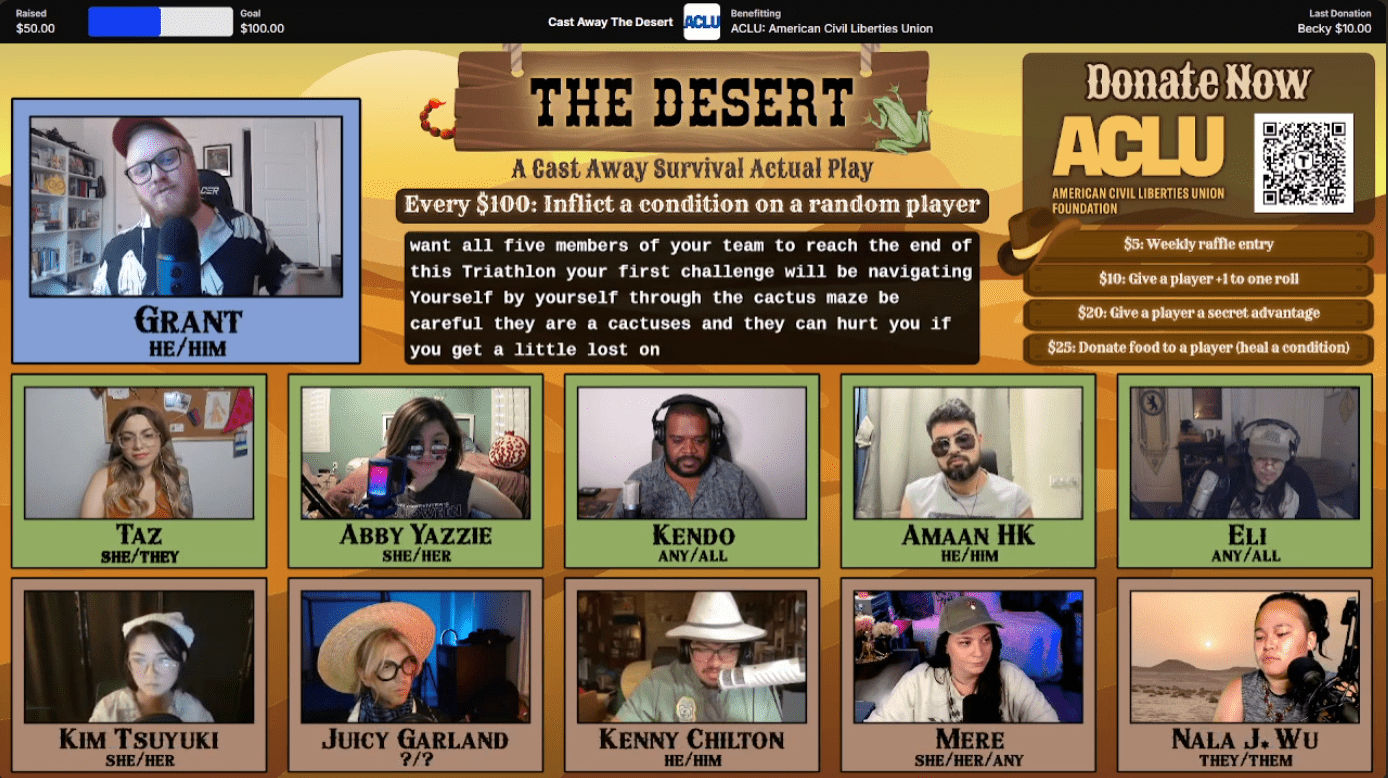
Panda: We’ve already mentioned that there are 11 people at maximum. I wanna know more about live camera switching.
Jien: So in the initial, season one of our inaugural launch of Cast Away, it was pretty much just a static overlay. I did add people to the overlay and remove them from the overlay as they’re being introduced. When one team is off-screen, I would take that team off-screen, but there was no change in the actual overlay.
It was just cameras going on and off. This past season in the Desert, we had some fun ideas. Grant was telling me about the confessional camera, which I’ve seen in other reality shows, I’m a big fan of Chopped and Bake Off, and I see the moments where they’re out of the scene talking to the producer behind the camera about what they’re thinking. I did a whole lot of research and automating with my shiny Stream Deck, and I managed to find a way to use a second overlay style, which was just Grant and the relevant contestant. I could have done a separate scene for every single possible combination of Grant plus contestant. I chose the hard way. I was like, I’m gonna have one scene, and I’m gonna set up some automation so that when I hit the button on the Stream Deck, it’ll activate that scene, and it’ll pick which camera to activate.
I would start putting little Easter eggs in the confessional overlay as people were eliminated. There was a little hotel in the background. I would put lights in each of the windows as people were eliminated. I’m hoping to build on that visual accessibility, just having a better visual representation of what’s going on. We’ve been learning new shit every single season. With every iteration of this show, we’ve added something new. One day, this is just gonna be a fucking hologram.
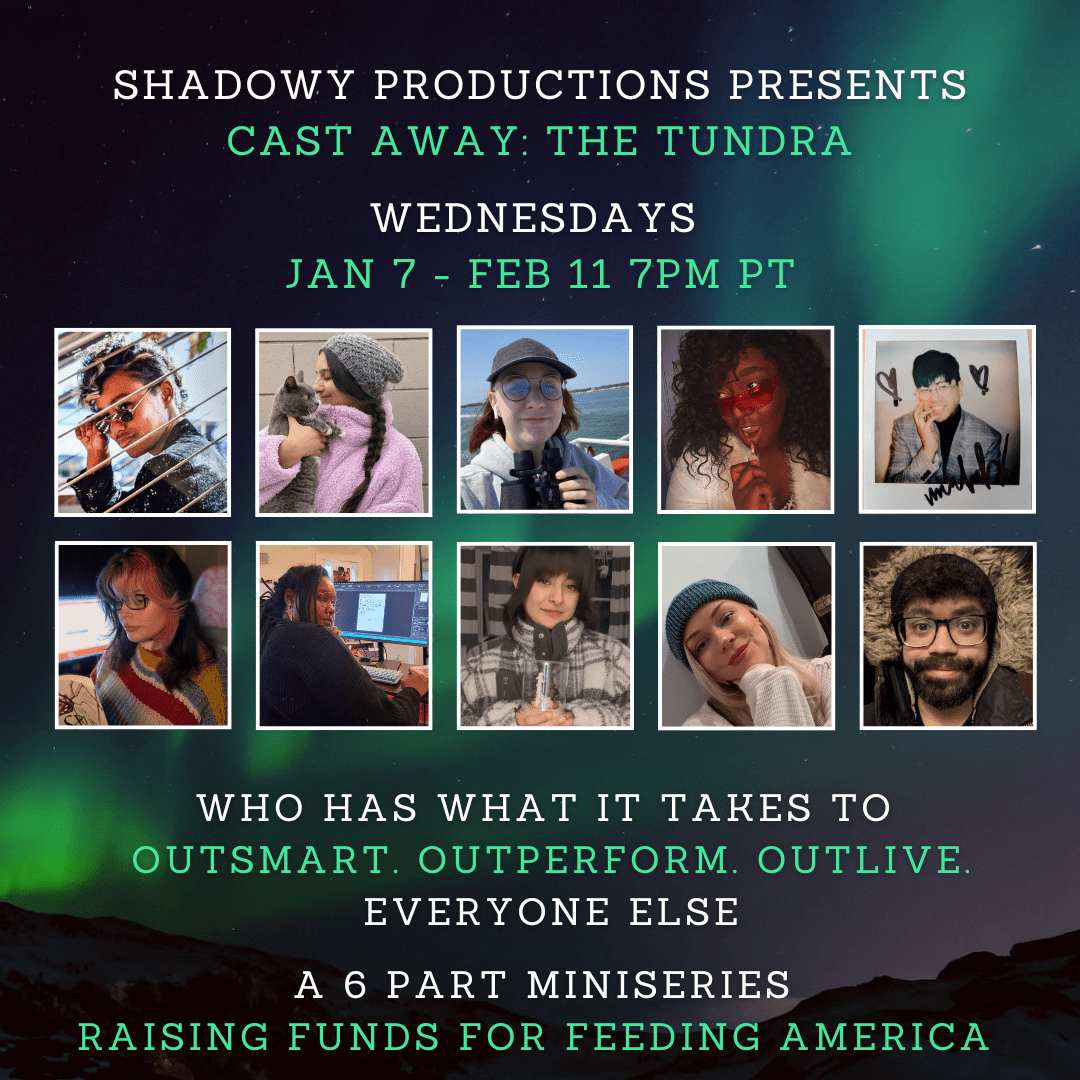
Grant: Tundra is by far our most ambitious season, narratively, game mechanic, and production-wise. All the lessons we’ve learned from the past two seasons across the board, as me as a [Game Master], Jien, and Sylvia producing, are really coming to a head in The Tundra. We’re trying a lot of different stuff to see what sticks and what doesn’t because we literally have on the books two more seasons of this that were locked in concept-wise and five more after that. We can literally keep this going for as long as we want to keep it on. I think we have enough Cast Away season ideas to last us five more years if we want to. We’re really swinging for the fences with Tundra to see what lands.
I do want to sing the praises of our third shadowy producer, Shadow Silvia, who has really upped our game a bunch. Having Silvia there to be that voice in my ear. So it’s just several less things that I have to keep track of. Oh my God, Silvia, when you read this, you are a fucking game changer.
So I’m not spinning every plate by myself, which has been a godsend and allows us to make bigger, stupider, more creative stuff. I would love to see Cast Away just become one of those massive tent poles in the scene. I think we’re on our way there. I would love this brand, if you will, this quote-unquote brand that definitely makes money, to just be one of those things where people look at it and go, this team is really doing something clever and different.
This season of Cast Away:The Tundra will feature a raffle to win signed copies of What a Horrible Knight and E.V.I.L. by Afterthought Committee (January 7th only) or a raffle for a full set of Long Dog Dice. This season is also sponsored by Plus One Exp!
You can watch Cast Away: The Tundra on Twitch.tv/GameMasterMonday Wednesday nights starting January 7th to February 11th at 7 PM PT. All proceeds raised will be donated to Feeding America.
Edit: Corrected the game system used.
Images via Game Master Monday.